|
|

|
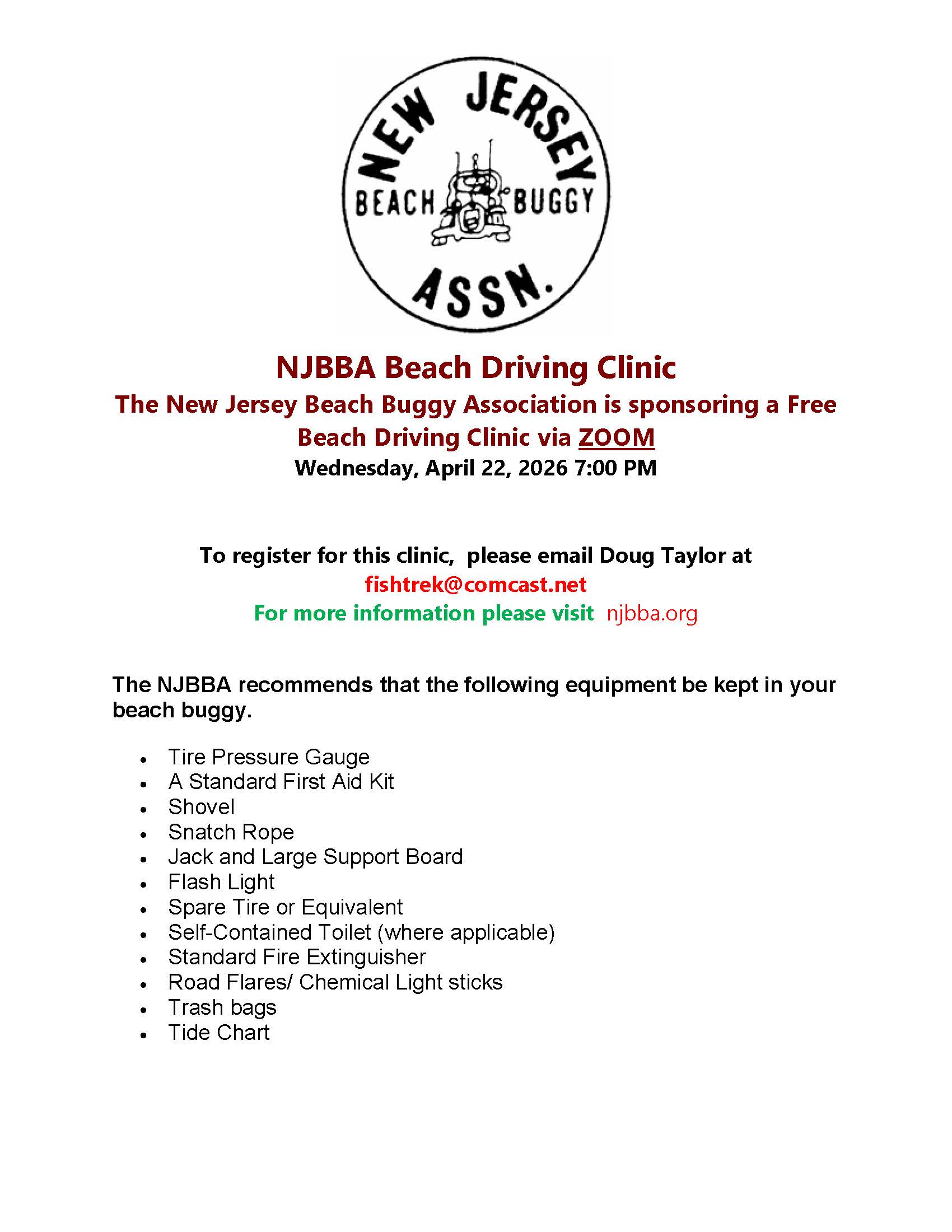
April 22nd 2026 Zoom Diving
Clinic 7pm
|
|
NJBBA Video on how
to drive on the beach
NJBBA video Click to watch |
|
This video, produced by the New
Jersey Beach Buggy Association (NJBBA), serves as an
instructional guide for the safe and legal operation of
vehicles on New Jersey beaches. It emphasizes that beach
driving is a privilege that requires specific equipment,
technical skills, and environmental awareness.
Here is an analysis and summary of
the key points covered in the video:
1. Definition & Compliance
The video clarifies that a "beach
buggy" is not a dune buggy or ATV. It must be a
registered, inspected, and insured four-wheel-drive (4WD)
vehicle that meets all state motor vehicle requirements.
Driving on the beach is permitted by federal, state, or
local authorities, and strict adherence to rules is required
to maintain this access.
2. Essential Preparation &
Equipment
Before entering the beach, vehicles
are often inspected for mandatory safety gear. The video
outlines a strict checklist of required items to ensure
safety and self-sufficiency:
-
Safety Gear: Fire
extinguisher, auto first aid kit, flashlight, and a
trash bag.
-
Recovery Gear: Spare
tire, tire gauge, shovel, tow chain/snatch line, and a
workable jack with a support board (plywood at least
5/8" x 12" x 12") to prevent the jack from sinking into
the sand.
-
Recreational Gear:
Fishing equipment and bait/tackle for every person over
12 years old (often a legal requirement for the permit).
-
Fuel: A minimum of
3/4 tank of gas is recommended.
3. Tire Pressure Strategy
A critical technical tip offered is
"airing down." Drivers should deflate tires to
approximately 15 PSI before entering the sand.
-
Analysis: This
increases the tire's surface area, allowing the vehicle
to "float" on top of the sand rather than digging into
it. The video warns that even a small difference (e.g.,
2 PSI) can significantly affect performance.
4. Driving Protocols &
Etiquette
-
Follow the Tracks:
It is safer and easier to drive in tracks made by
previous vehicles.
-
Right of Way:
Vehicles leaving the beach generally have the
right of way However, if two vehicles meet head-on in a
single track, the driver with the dunes on their
right should yield by pulling out of the track.
-
Speed & Gearing:
Maintain a steady speed (around 10 mph) in a gear where
the engine isn't laboring or racing. This provides
enough momentum to get through soft spots without
overheating the engine.
-
Protecting the Dunes:
Never drive or walk on the dunes. Doing so damages the
foliage that protects the beach and violates NJBBA
philosophy.
5. Emergency Procedures
6. Parking Tip
Avoid parking with the front of
the vehicle facing the ocean. The salt spray from the ocean
breeze can damage ignition components and disable the
vehicle's electronics.
|
|
Past driving clinic's information and
pictures are below |
|
Brigantine Driving
Clinic 4/18/2020
Click to download PDF details
Island Beach Driving Clinic
4/19/2020
Click to download PDF details
|
|
EQUIPMENT:
(This is mandatory on mt beaches)
Permit for appropriate beach *Fire
extinguisher *First aid kit *Jack *Jacking board (12"x12")
*Shovel *Snatch rope/strap *Flash light *Spare tire *Tire
pressure gauge *Road flare *At least ½ tank of fuel.
|
|
|
SAFETY RULES:
-
USE COMMON SENSE!
-
Always consider the weather before attempting a beach outing and the tide when deciding where to park on the beach.
-
Watch where you're going. Always be cautious of your surroundings (bathers, animals, other vehicles, debris in the tracks, etc.).
-
Yield to other vehicles if possible, rather than causing someone to get stuck.
-
Speed limits: Obey them for your own, as well as, someone else's safety.
-
Never drive or walk on the dunes. It is an offense in a State Park!
-
Think about your actions and how they will effect: access, the next beach user, the environment etc.
-
Always take your trash and a little extra off the beach with you.
-
If you use a beach that permits fires, be sure the fire is out and buried before you depart.
|
VEHICLE INFO:
-
4-wheel drive is mandatory on almost all beaches and is RECOMMENDED.
-
Horsepower: Too much can hurt as much as it can help Easy on that throttle! Slow and Steady!
-
Tires: Standard tread design as compared to mud tread (mud tires are for mud and not sand). Almost all tires must be aired down to
15lbs. to 18lbs.
(depending on vehicle weight). Be sure to exercise caution when driving to an air up location. Low tires offer poor handling on a hard road surface.
-
4-wheel high gear vs. low gear: This needs to be determined on a per vehicle basis.
-
Washing down your vehicle after a trip to the beach is critical if you intend to keep that vehicle. A good coat of wax will help with the removal of salt spray.
-
Maintenance is important. Full grease fittings will not allow sand to enter, and a well maintained vehicle will not leak harmful fluids onto the beach.
|
|
BEACH DRIVING:
-
ALWAYS air down!
Use caution not to get sand in stem or cap. Lowering your tire pressure is easier on your vehicle, on the beach and on the next person to come on the beach.
-
Plan your movements. Try not to make last minute decisions. Cross ruts gradually and avoid hard turns. Use pre-existing ruts when possible.
-
If you start to get stuck
STOP! There is no hard bottom; you will just continue to dig a hole. The throttle is not the answer. Attempt to back up into your own ruts, air down, dig out or get help.
-
If you need to be pulled out, always have the towed vehicle in gear if possible. Do not dead pull, a snatch strap and tension is usually all that is needed. Try to avoid 30mph jerk outs they are hard on all the equipment and very dangerous to those nearby.
-
Always fill in the holes that are created when you get stuck; the next person will thank you!
-
If your vehicle runs hot from beach driving, turn it into the wind and open the hood. Do not shut it down hot!
|
COURTESY PATROL:
-
Courtesy patrol is a group of
NJBBA members who give up their time to assist other beach users. They can be identified by a flag or door sticker on their vehicle. If you need assistance flag down any
Courtesy Patrol Member and they will be happy to assist you If at all possible. If you are interested in joining the New Jersey Beach Buggy Association and being part of our
courtesy patrol contact any member here today or visit our website at
www.njbba.org
|
|
REMEMBER TO USE COMMON SENSE AND A LOT OF YOUR BEACH DRIVING CONCERNS WILL BE
UNWARRANTED!! |
|
|
|
|
|
|
|
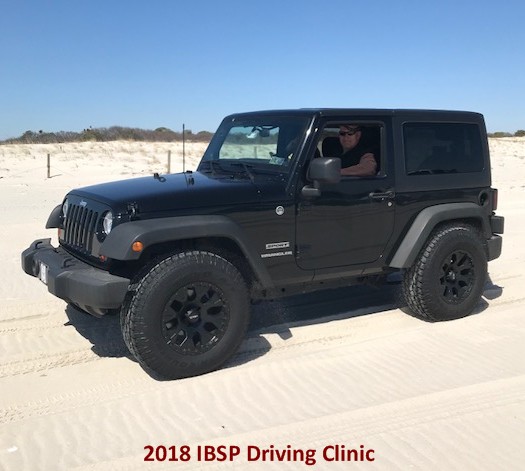
IBSP Beach Driving Clinic
4/8/2018
Pictures by Maureen Bailey
|
Brigantine Driving
Clinic
4/7/2018
Pictures by Bob Conover |
|
We had a great showing of 42
students that wanted to learn the proper handling of driving on the
beach. Thanks to the NJBBA Volunteers this was accomplished in a
safe way. Weather was very nice for these first time drivers on
Island Beach State Park. |
|
|
|
|
|
|
| |
|
|